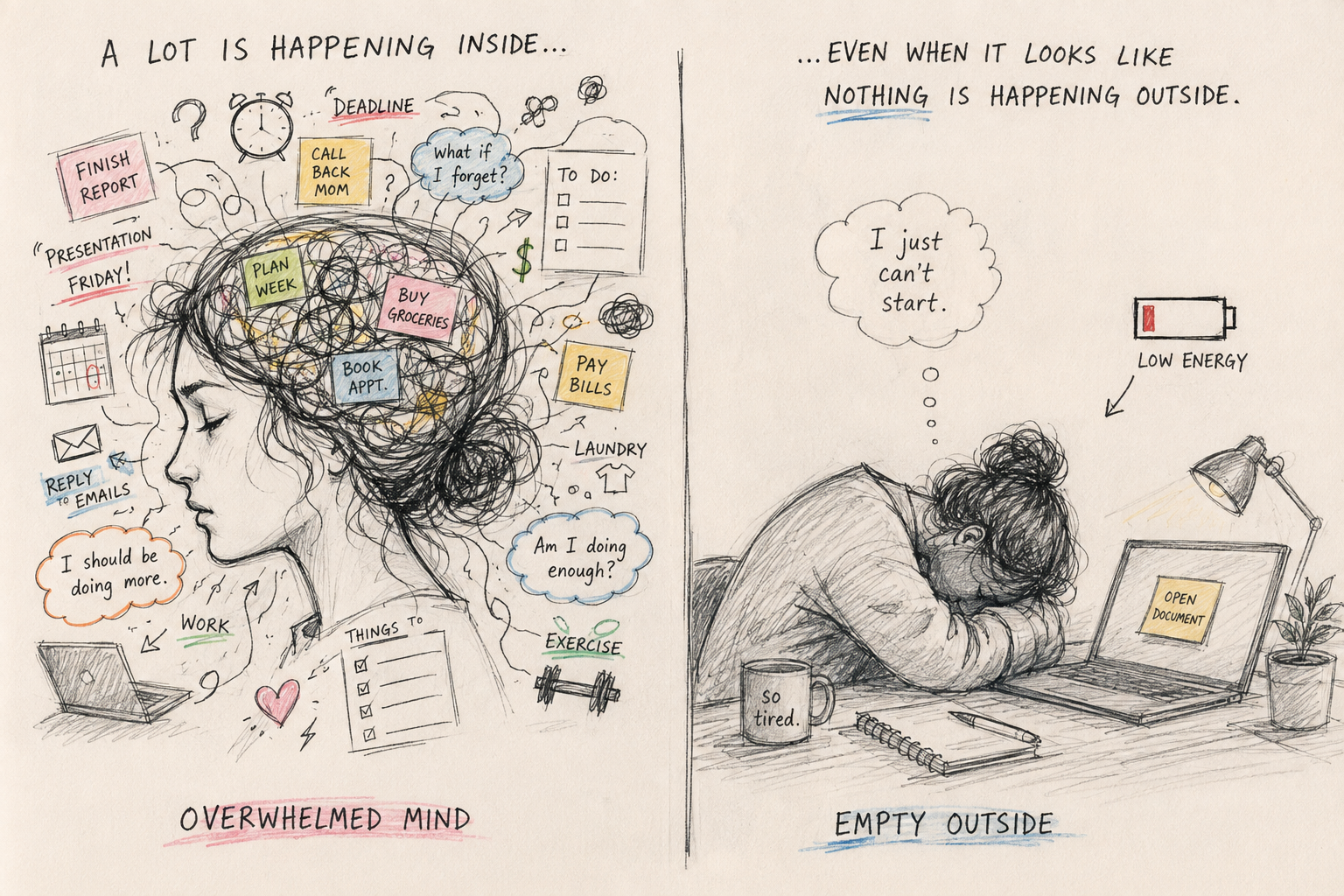
Have you ever stared at something you know you need to do and thought: “Why can’t I just do it?”
- 📧 The email needs answering.
- 🧺 The laundry needs folding.
- 📊 The report needs finishing.
- 🗓️ The appointment needs booking.
You know what needs to happen. You may even want to do it. But somehow, you cannot seem to get started.
You procrastinate. You become distracted. You jump between tasks. You spend hours thinking about everything you need to do without actually doing much of it, and then comes the guilt:
- 💭 “I’m so lazy.”
- 💭 “I’m wasting my day.”
- 💭 “Why is everyone else able to manage this?”
- 💭 “I just need more discipline.”
But what if the problem isn’t that you don’t care? What if your brain is simply overloaded?
💡 First, What Is Executive Dysfunction?
Executive functions are the mental skills that help us manage ourselves and turn intentions into actions. Think of them as the brain’s internal management system.
Executive dysfunction occurs when some of these processes become difficult to access.
🚨 Important: Executive dysfunction is not the same thing as laziness. You can genuinely want to do something, know how to do it, and still struggle to translate that intention into action.
🔄 The “I Know, But I Can’t” Gap
One of the most frustrating aspects of executive dysfunction is the endless loop between knowing and doing:
- 🧠 Knowing “I need to answer that email.”
- 💭 Intending “I’ll do it right after lunch.”
- 📱 Distraction “I’ll just check my phone real quick first.”
- 😰 Overwhelm “Now I have six other urgent things piling up.”
- 💔 Self-Criticism “Why am I like this?”
- 🚪 Avoidance “I’ll just deal with everything tomorrow.”
↳ And the cycle repeats.
This is not necessarily a problem of motivation. Sometimes a task has simply become too cognitively or emotionally expensive to initiate.
🔥 Executive Dysfunction + Burnout
Executive dysfunction and burnout feed directly into one another, creating a compounding downward spiral:
- 🧠 Executive Dysfunction: You struggle to start, organize, prioritize, or complete tasks.
- 📚 Tasks Accumulate: Emails stack up, chores pile high, and deadlines loom.
- 😰 Stress Increases: Your brain constantly reminds you about everything undone.
- ⚡ You Push Harder: You overwork, stay up late, or rely on panic-fueled urgency.
- 🚀 Temporary Productivity: Adrenaline forces things across the finish line.
- 🪫 Exhaustion: You end up completely mentally and physically depleted.
- 🔥 Burnout: Your core capacity to focus and regulate drops significantly.
- 📉 Functions Worsen: Even basic responsibilities begin to feel impossible.
⚡ Sometimes what looks like procrastination is actually a nervous system that has been running on empty for far too long.
🔎 Where Does Burnout Fit In?
Burnout is more than feeling tired after a busy week. It develops when prolonged demands consistently exceed your available capacity.
🪫 Emotional Exhaustion: Feeling completely drained, depleted, or hollow.
🌫️ Mental Brain Fog: Difficulty concentrating, making decisions, or thinking clearly.
📉 Reduced Motivation: Things that once felt manageable now feel completely pointless.
😤 Detachment & Irritability: Feeling cynical, impatient, or emotionally distant.
💭 Loss of Efficacy: Feeling like no matter how hard you work, it is never enough.
When you are burnt out, your executive capacity shrinks. The real question often isn’t “Why can’t I be more productive?”, it’s “Has my overall capacity been depleted?”
🧠 The Mental & Emotional Toll
20 Browser Tabs Open at Once
Even when resting, your brain is processing unfinished tasks in the background:
“I need to call them back.”
“I forgot to reply.”
“I need to book that appointment.”
“I still haven’t cleaned.”
This constant background processing leads to severe mental overload, decision fatigue, anxiety, and an inability to truly relax.
💔 The Emotional Cascade
Over time, unresolved tasks become linked with heavy emotions:
- 😔 Guilt: “I should have done this days ago.”
- 😞 Shame: “What is wrong with me?”
- 😤 Frustration: “Why is this simple thing so hard?”
Eventually, you aren’t just avoiding the task; you are avoiding the painful emotions attached to it.
🧍 Physical Symptoms & Patterns
When chronically overwhelmed, your body absorbs the impact:
🎢 The All-or-Nothing Rollercoaster
- 🛑 Nothing: Struggling to initiate for hours or days.
- ⚡ Everything: Panic triggers an intense, hyper-focused burst of work.
- 💥 Crash: Complete physical and mental depletion.
- 🛑 Nothing Again: Starting the next task feels even harder.
⚠️ The Perfectionism Trap
Perfectionism and executive dysfunction are a toxic pairing:
Procrastination → Panic → Perfectionistic Effort → Exhaustion → Crash
Instead of asking “How can I do this perfectly?”, try asking:
“What would ‘good enough’ look like right now?”
A completed, imperfect task is endlessly more useful than a perfect task that stays in your head.
🌱 Practical Strategies That Actually Help
The goal is not to force yourself to work harder; it is to reduce the activation energy required to begin.
- Make the First Step Ridiculously Tiny
❌ “I need to clean the house.” ➔ ✅ “I will put 5 items away.”
❌ “I need to write the report.” ➔ ✅ “I will open a blank document.” - Offload Your Brain (External Memory)
Stop relying on mental bandwidth. Use calendars 📅, paper lists 📝, phone alarms ⏰, and sticky notes 📌. Externalizing memory reduces cognitive load. - Stop Asking “What Should I Do?”
When overwhelmed, prioritize by asking: “What is ONE thing that would make today slightly easier if it were done?” - Break Projects into Micro-Actions
❌ “Prepare presentation” (This is a complex project)
✅ “Open presentation software and write the title slide” (This is an actionable step) - Use the 10-Minute Rule
Set a timer for 10 minutes. Promise yourself you can stop when it rings. Simply starting eliminates most of the resistance. - Try Body Doubling 👥
Work alongside someone else. Sit in a library, join a virtual co-working space, or have a friend sit in the room. External presence provides subtle focus and accountability. - Eliminate Physical Friction
💧 Want to drink more water? Keep the bottle in plain sight.
👕 Need to workout? Set clothing out the night before. - Pair Boring Tasks with Dopamine Boosts
🎧 Listen to podcasts while folding laundry.
☕ Grab your favorite drink while tackling emails. - Build Routines Over Relying on Motivation
Motivation fluctuates; simple routines eliminate the energy spent negotiating with yourself every morning. - Prioritize Recovery Over Optimization
You cannot productivity-hack your way out of total depletion. Sometimes the solution isn’t a new planner, it’s rest, boundaries, and lower expectations.
🌿 Replace Self-Criticism with Curiosity
When you get stuck, swap out judgment for investigation:
❌ “What is wrong with me?”
✅ “What barrier got in my way?”
(Was the task too vague? Was I exhausted? Was I afraid of making a mistake?)
Shame locks you in place; curiosity gives you actionable data.
🌸 You Are More Than What You Get Done
Your worth is not a productivity score.
You are not lazy because something is difficult.
You are not irresponsible because you need reminders.
You are not incapable because your capacity changes day to day.
You do not need to earn your right to rest.
🌱 A Small Place to Start Today
If everything feels overwhelming right now, take a breath and follow this path:
- Choose ONE tiny thing.
- Make it smaller.
- Remove one physical barrier.
- Set a timer for 10 minutes.
- Start.
Your brain doesn’t always need more pressure; sometimes it’s just asking for a different kind of support.
Ana Sharma
Clinical Therapist
August 17, 2026